This is the sweet rehearsal of my thought,
These words are silent markers of my will.
I long to live, regain what I forgot,
And find my soul ablaze within me still.
Life burns, but who knows why we came to be?
I thought it was to love, strange then it seems
That those I seek to know fly fast from me,
And mock the fading hope I find in dreams.
Am I not warm and gentle, like the rain
That mists before our eyes in passing spring?
I fear I'll walk alone, that all is vain,
And all my hope no love or peace will bring.
And yet, since I may find her, I rehearse,
That she would feel Christ's love in my sweet verse.
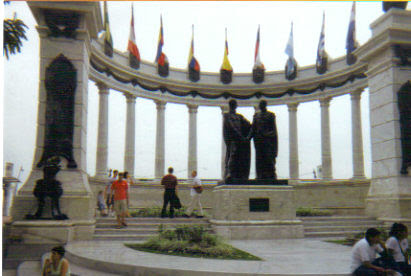
Bolivar and San Martin: Guayaquil, Ecuador
Friday, January 04, 2008

Thursday, December 27, 2007
Hunger Satisfied
I found my book,
the stunning compilation
of Neruda's Odes.
Sure enough it's there--
"the bread of her fragrance"--
it's the penultimate line of Ode to Love,
in case you were wondering too.
I decided to peruse the entire volume,
but progress is slow.
The odes to Happiness
and to Love are full and complete
and erupt with such passion
that so far I have managed
to read just those first two
over and over.
"My hands are narrow:
the depths of my eyes, humble
to receive
her treasures,
the unbounded cascade of radiance,
the golden thread,
the bread of her fragrance:
they are simply, Love, my life."
I could move on.
There are, after all,
hundreds of pages that follow.
But the words are rich
as though they themselves possess
the power to sustain.
Perhaps this is what he meant
when he spoke of permanent bread.
the stunning compilation
of Neruda's Odes.
Sure enough it's there--
"the bread of her fragrance"--
it's the penultimate line of Ode to Love,
in case you were wondering too.
I decided to peruse the entire volume,
but progress is slow.
The odes to Happiness
and to Love are full and complete
and erupt with such passion
that so far I have managed
to read just those first two
over and over.
"My hands are narrow:
the depths of my eyes, humble
to receive
her treasures,
the unbounded cascade of radiance,
the golden thread,
the bread of her fragrance:
they are simply, Love, my life."
I could move on.
There are, after all,
hundreds of pages that follow.
But the words are rich
as though they themselves possess
the power to sustain.
Perhaps this is what he meant
when he spoke of permanent bread.
Wednesday, December 26, 2007
Searching for My Bread
I've been tearing my room apart,
searching for a book called
"The Odes of Neruda"
I have this phrase--
"the bread of her fragrance"--
running through my mind,
and it fills me with
such amazement that I must
return to the text and
make certain it is real.
How succinct.
How poetic.
How marvellously Neruda.
The woman's fragrance as bread,
intangible calories to nourish the intangible soul.
If I am remembering this correctly
then this is something everyone should read.
But the book still escapes me
amid this confounded clutter,
and without the words before me
I am slow to say something so perfect
is real.
searching for a book called
"The Odes of Neruda"
I have this phrase--
"the bread of her fragrance"--
running through my mind,
and it fills me with
such amazement that I must
return to the text and
make certain it is real.
How succinct.
How poetic.
How marvellously Neruda.
The woman's fragrance as bread,
intangible calories to nourish the intangible soul.
If I am remembering this correctly
then this is something everyone should read.
But the book still escapes me
amid this confounded clutter,
and without the words before me
I am slow to say something so perfect
is real.
Thursday, December 20, 2007
meus uxor
She'll walk in peace, the envy of the world,
My words will thrive until she lives in fame.
I'll give her names like "might of God unfurled"
And all my verse her wonders will proclaim.
Her beauty won't be that of common themes,
She'll shun cliches which fecklessly will try
To sing her worth, for only in my dreams
Are words of praise her beams will not defy.
My heart will be her garden, there she'll sow
The strongest seeds of love and hope in me,
She'll stare in awe, unblinking, as I grow
Into the finest man that I can be.
And we will never die, through verse and rhyme
Our love will paint the hallowed halls of time.
My words will thrive until she lives in fame.
I'll give her names like "might of God unfurled"
And all my verse her wonders will proclaim.
Her beauty won't be that of common themes,
She'll shun cliches which fecklessly will try
To sing her worth, for only in my dreams
Are words of praise her beams will not defy.
My heart will be her garden, there she'll sow
The strongest seeds of love and hope in me,
She'll stare in awe, unblinking, as I grow
Into the finest man that I can be.
And we will never die, through verse and rhyme
Our love will paint the hallowed halls of time.
Wednesday, December 05, 2007
To Wordsworth (Chicago, 2007)
One-hundred fifty-seven years gone by
Since human ears were graced with your fair voice.
Yet Wordsworth, all our art must still comply
With your fair words--we read them and rejoice!
Your rhythms flowed in song across the page,
Each syllable expressed your human heart.
But more than man--a teacher, friend and sage,
You shared your love so that you might impart
In all the wonder that it is to be,
In all the glory of their inward soul,
Long dead, but still your might lives on in me
And all my verses your proud verse extol.
No more is my truth locked in ivory tower,
Your words bestow me virtue, freedom, power.
Since human ears were graced with your fair voice.
Yet Wordsworth, all our art must still comply
With your fair words--we read them and rejoice!
Your rhythms flowed in song across the page,
Each syllable expressed your human heart.
But more than man--a teacher, friend and sage,
You shared your love so that you might impart
In all the wonder that it is to be,
In all the glory of their inward soul,
Long dead, but still your might lives on in me
And all my verses your proud verse extol.
No more is my truth locked in ivory tower,
Your words bestow me virtue, freedom, power.
Monday, December 03, 2007
Not Touched By Frost
Melancholy but a moment,
Life lunges forward into peace renewed.
At last I cheat despair,
who courts my time with ceaseless chase.
At last, it seems,
The hope of Christ takes root.
Life lunges forward into peace renewed.
At last I cheat despair,
who courts my time with ceaseless chase.
At last, it seems,
The hope of Christ takes root.
Friday, November 23, 2007
Anywhere, America 2007
They're building.
all of America heaves at once,
their dreams manifesting
into forests of concrete and steel.
They won't stop until they
can piously worship at
altars of consumerism on every corner.
They pray the only prayers they know:
red tag sale, buy one get one free,
half-off everything Saturdays before noon,
sign up now for a Buyer's Card and save.
They're building.
They're squeezing America into a single strip mall,
That way we can all be sure our clothes are in fashion
and our coffee tastes the same.
We want to be certain we're getting real bargains
on the things we buy irrespective of how
useless or wasteful they might be.
London, 1802.
If my master's world
was a fen of stagnant waters then,
what odors would oppress his nostrils
If he walked with me today?
all of America heaves at once,
their dreams manifesting
into forests of concrete and steel.
They won't stop until they
can piously worship at
altars of consumerism on every corner.
They pray the only prayers they know:
red tag sale, buy one get one free,
half-off everything Saturdays before noon,
sign up now for a Buyer's Card and save.
They're building.
They're squeezing America into a single strip mall,
That way we can all be sure our clothes are in fashion
and our coffee tastes the same.
We want to be certain we're getting real bargains
on the things we buy irrespective of how
useless or wasteful they might be.
London, 1802.
If my master's world
was a fen of stagnant waters then,
what odors would oppress his nostrils
If he walked with me today?
Tuesday, November 06, 2007
Un alumno escogido
Olvídate la Malinche.
Hijo de la Chingada no veo aquí.
Mas bien hijo afortunado,
Y heredero escogido de un legado doble
Y repleto con nobleza: legado del toro y del jaguar.
Bastardo jamás,
Sino hijo legítimo de
La sabiduría de Nezahualcoyotl,
Su canción de amor y filosofía
Corriendo en tu sangre,
Tanto como el humanismo de Cervantes,
O los romances del Cid que fueron
Los heraldos de tu fuerza.
Toro y jaguar, animales orgullosos y fuertes,
Estremeciendo a sus pares
Con su voluntad invicto.
Sube a nacer de nuevo, entonces,
Llevando en la corazón el poder
Y amor de tus antepasados.
Hijo de la Chingada no veo aquí.
Mas bien hijo afortunado,
Y heredero escogido de un legado doble
Y repleto con nobleza: legado del toro y del jaguar.
Bastardo jamás,
Sino hijo legítimo de
La sabiduría de Nezahualcoyotl,
Su canción de amor y filosofía
Corriendo en tu sangre,
Tanto como el humanismo de Cervantes,
O los romances del Cid que fueron
Los heraldos de tu fuerza.
Toro y jaguar, animales orgullosos y fuertes,
Estremeciendo a sus pares
Con su voluntad invicto.
Sube a nacer de nuevo, entonces,
Llevando en la corazón el poder
Y amor de tus antepasados.
Monday, November 05, 2007
Faith and Reason
Why, the atheist asks, if God so loved the world did he wait almost 100,000 years (we all know through science that the modern human brain has existed for that amount of time) to tell human kind through the sacrifice of Christ? Did he not care about the people who lived and toiled before the time of Christ? Allow me to conjecture for a moment. If, as the atheist so ardently believes, Darwinism is the tool of design that has brought about the rise of man, would that not also make sense as a mode of God's creation? If God did design through evolution, wouldn't He wait until the mind of man evolved to the point where he could communicate verbally (circa 50,000 years ago BTW) and moreover until he could conceptualize and at least partially understand the concepts of love and hope and freedom that were the Message that Christ conveyed to the world. If the Messiah had shown up at the start of things like Christopher Hitchens seems to think He should have, the Message of God's love would have fallen on ears that never could have come to understand it.
My response, ex post facto
It's true, Nietzsche.
I will cede that in some places
in this world God is most certainly
dead.
And the denizens of these hamlets:
London and Paris, Vienna, Moscow, New York,
and even in Rocken where your father
extolled the hope of Christ
they share the fruits
of your philosophy of despair.
They walk with fearless footsteps of defiance,
And thump their chests in pride, thinking
how cosmopolitan their
cosmology of disbelief has become.
But at night, and in sober reflection
They wail because in their hearts
they believe they are alone.
They believe this because
you told them of the Death of God,
and assured them this time
there was no chance
Of finding an empty tomb.
And since they are alone
They do not hope,
They do not dream,
They are not fruitful and they do not multiply.
Why love if God is dead?
For what is love if it is not forever,
A brilliant strand of light that burns and
shoots forth from the mind of man
to join itself to the eternal
light of love and peace with God?
Strength to them, your students,
those who know, like the Other who sought to
hunt God from His throne, that the field is lost.
And now with feckless faith they
turn to study of revenge and deathless hate.
Buoy them up with dreams of the unconquerable Will.
But know it was not glory
Christ sought while dying in agony
upon the Cross,
nor to extort from you submission
to His inexorable might and wrath.
He bled, dreaming a dream of love,
The same love of life and hope of peace that
you spurned in thought, word, and deed.
I will cede that in some places
in this world God is most certainly
dead.
And the denizens of these hamlets:
London and Paris, Vienna, Moscow, New York,
and even in Rocken where your father
extolled the hope of Christ
they share the fruits
of your philosophy of despair.
They walk with fearless footsteps of defiance,
And thump their chests in pride, thinking
how cosmopolitan their
cosmology of disbelief has become.
But at night, and in sober reflection
They wail because in their hearts
they believe they are alone.
They believe this because
you told them of the Death of God,
and assured them this time
there was no chance
Of finding an empty tomb.
And since they are alone
They do not hope,
They do not dream,
They are not fruitful and they do not multiply.
Why love if God is dead?
For what is love if it is not forever,
A brilliant strand of light that burns and
shoots forth from the mind of man
to join itself to the eternal
light of love and peace with God?
Strength to them, your students,
those who know, like the Other who sought to
hunt God from His throne, that the field is lost.
And now with feckless faith they
turn to study of revenge and deathless hate.
Buoy them up with dreams of the unconquerable Will.
But know it was not glory
Christ sought while dying in agony
upon the Cross,
nor to extort from you submission
to His inexorable might and wrath.
He bled, dreaming a dream of love,
The same love of life and hope of peace that
you spurned in thought, word, and deed.
Sunday, November 04, 2007
Rendición
Imagen de luz,
pura luz entrando por
las puertas permeables
de los ojos.
Algo me mueve
a pensar en
las palabras de Tomas Aquino,
algo animándome a reconocer
el poder de Dios
en la creación que me envuelve
pura luz entrando por
las puertas permeables
de los ojos.
Algo me mueve
a pensar en
las palabras de Tomas Aquino,
algo animándome a reconocer
el poder de Dios
en la creación que me envuelve
Thursday, November 01, 2007
D'Souza-Hitchens Debate "Is Christianity the Problem?"
It's up on youtube, and it is fantastic. They go after each other with history, philosophy, and even some really good humor. The best line of the debate comes when Mr. D'Souza calls on Dostoevsky for support: "If God is not, then everything is permitted." He brings that up to corroborate his assertion that atheistic, not Christian regimes, are responsible for the great crimes of history (think Crusades and Inquisition versus Stalin, Hitler, Pol Pot, Fidel Castro, Kim Jong-Il, all who would wipe out Christianity if given the chance). I also love Mr. D'Souza's line that atheism is not an intellectual, but a moral rebellion. Another great moment came when a man from Tonga asked Mr. Hitchens how religion can poison everything when Christianity brought his country out of the dark ages of cannibalism, poverty, and abject despair.
Wednesday, October 31, 2007
Words
Word after word I cultivate the line,
Until each phrase can seemingly express
the very colors of these thoughts of mine,
It must be true, but also finely dressed.
It won't suffice to say that I am sad,
Or that I'm happy, no that will not do,
The rhythm of the line must show I'm glad
Or else, in contrast, paint with darkest blue.
Swift song that speeds in haste across the page,
Slow song, winding, crawling upon the earth,
Each has its place in this and every age
For all have songs of sadness and of mirth.
Words are our gifts, the spark-spray of the soul,
Through them the worth of man we may extol.
Until each phrase can seemingly express
the very colors of these thoughts of mine,
It must be true, but also finely dressed.
It won't suffice to say that I am sad,
Or that I'm happy, no that will not do,
The rhythm of the line must show I'm glad
Or else, in contrast, paint with darkest blue.
Swift song that speeds in haste across the page,
Slow song, winding, crawling upon the earth,
Each has its place in this and every age
For all have songs of sadness and of mirth.
Words are our gifts, the spark-spray of the soul,
Through them the worth of man we may extol.
Monday, October 29, 2007
Esperanza
We called her "Esperanza"
In Spanish class
all those years ago.
Bright-eyed Esperanza
whose face seemed locked
in perpetual smile.
Smiling Esperanza who talked
of nothing but happiness and hope.
Now the face she wears
Belies her age: too much weariness,
Too much grief.
She's far too young to be framed in bar-haze,
Cutting through smoke
and unfamiliar faces
to bring people their cocktails
and a perfunctory smile.
She passes me a third time,
It's clear she does not recognize me,
Gregorio, as I was called.
Gregorio who watched her so lovingly
All those years ago.
Perhaps she does see something
in my eyes as our gazes meet,
But she cannot delve into the past,
back into times when her blue eyes
Scintillated with happiness and hope.
Alas, dear Esperanza,
how quickly the young heart grows old.
In Spanish class
all those years ago.
Bright-eyed Esperanza
whose face seemed locked
in perpetual smile.
Smiling Esperanza who talked
of nothing but happiness and hope.
Now the face she wears
Belies her age: too much weariness,
Too much grief.
She's far too young to be framed in bar-haze,
Cutting through smoke
and unfamiliar faces
to bring people their cocktails
and a perfunctory smile.
She passes me a third time,
It's clear she does not recognize me,
Gregorio, as I was called.
Gregorio who watched her so lovingly
All those years ago.
Perhaps she does see something
in my eyes as our gazes meet,
But she cannot delve into the past,
back into times when her blue eyes
Scintillated with happiness and hope.
Alas, dear Esperanza,
how quickly the young heart grows old.
Friday, October 26, 2007
Tormenta de vida
Tormenta parecías,
Tus palabras agregándose como
Nubes amenazadores.
Tus ojos: destellando relámpago,
Electrificando e iluminando
El cielo gris de mi vida.
Tu boca: el estuche del trueno,
Sus palabras clavando
Mi pensamiento y mi silencio
Con sonidos poderosos y espontáneos.
Tus palabras agregándose como
Nubes amenazadores.
Tus ojos: destellando relámpago,
Electrificando e iluminando
El cielo gris de mi vida.
Tu boca: el estuche del trueno,
Sus palabras clavando
Mi pensamiento y mi silencio
Con sonidos poderosos y espontáneos.
Night
Sleep comes
with eyes quickly closing,
Windows opening
to the wider world within.
dreaming of words
that cut the air
as you spoke them,
unfiltered as they rose
from the soul to the lips...
with eyes quickly closing,
Windows opening
to the wider world within.
dreaming of words
that cut the air
as you spoke them,
unfiltered as they rose
from the soul to the lips...
Tuesday, October 23, 2007
C.S. Lewis
I am about to read "What's So Great About Christianity" by Dinesh D'Souza, which is anticipated to be the finest work of Christian apology since C.S. Lewis' "Mere Christianity". At last we have a scholarly text to combat the recent onslaught of atheists like Richard Dawkins and Christopher Hitchens (author's note: Mr. Hitchens is an intelligent, well spoken man, however I feel his idea that "religion poisons everything" is both misguided and dangerous. Anyhow, in honor of the erudite and faithful work of C.S. Lewis, I am choosing my favorite quote of his to post here:
"I believe in Christianity like I believe in the sun: not because I see it, but because by it I see all things."
"I believe in Christianity like I believe in the sun: not because I see it, but because by it I see all things."
Monday, October 22, 2007
Hollow Discourse
An entire month
of shame and heartache
Spills slowly onto
open palms.
She speaks as though
the remedy for this is sorrow,
as if tears could somehow bring color
to my disparate shades of gray.
of shame and heartache
Spills slowly onto
open palms.
She speaks as though
the remedy for this is sorrow,
as if tears could somehow bring color
to my disparate shades of gray.
Tuesday, October 02, 2007
To S-
I've penned a thousand lines, and still my pen
Could never trace the pain that you must feel.
The silence strong, your heartbreak so unreal,
Such is the gift and curse of mortal men.
We love til sadness calls on us again,
A moment here or there our hearts might steal.
But broken hearts will make our bodies kneel,
What comfort will assuage our sorrow then?
I wish that I had more for you than this,
Or that each penstroke could erase your pain,
I'd write until once more you found your bliss.
We love, and lose, but never love in vain,
Recall true love, hold close true love's first kiss,
Its power helps the wounded heart sustain.
Could never trace the pain that you must feel.
The silence strong, your heartbreak so unreal,
Such is the gift and curse of mortal men.
We love til sadness calls on us again,
A moment here or there our hearts might steal.
But broken hearts will make our bodies kneel,
What comfort will assuage our sorrow then?
I wish that I had more for you than this,
Or that each penstroke could erase your pain,
I'd write until once more you found your bliss.
We love, and lose, but never love in vain,
Recall true love, hold close true love's first kiss,
Its power helps the wounded heart sustain.
Tuesday, September 18, 2007
occasus verum
They talk about aggression like the West invented it. Like before Europe there were never any wars, and no one died under the hand of his brother. Think state of nature, people. Today, in Iraq, we see what happens when you destroy the Leviathan and fail to replace it with an equal or greater authority: war breaks out, every man versus every man, and blood runs in the streets while child-bereft mothers wail in the darkness. But is this the legacy of the West? No, this is the legacy of all mankind. Who stormed the pass at Thermopylae ten years after coming ashore with hopes of plunder at Marathon? Who conquered west to the Straits of Gibraltar and east to the steps of Kashmir in less than a hundred years? Who assailed Constantinople for 800 years before finally achieving the bloody goal? The Crusades did not begin this clash of civilizations, they were merely another phase in a conflict that dates back to antiquity, even before the Son of Man walked the earth or the Prophet spoke aught of the mind of God.
Subscribe to:
Posts (Atom)
